Menu
Support Portal BlogEN|DE

LTO Tape Storage

Why choose LTO Tape?

With ever-growing storage demand – especially in the media industry – due to the amount of material shot and larger video formats, finding the best storage media is a more pressing problem than ever. LTO tape remains the obvious choice and will continue to do so in the future. Why?

1. Balance the risks

Each media technology has its specific risks and benefits. To limit technology-related risks, it is necessary to use different media for saving data.

Disk dominates the storage landscape by far. To balance its risks and optimize for minimum total risk, other media are necessary. Optical media such as DVDs and BluRay are on decline because their reliability, read/write speed and capacity just aren’t sufficient

Only one other medium has a proven track record for professional data security while holding larger amounts of data. That is LTO Tape (for Linear Tape Open).
The LTO consortium is comprised of IBM, HP, and Quantum. The LTO norm is a bit of a stroke of luck in the history of IT.

The best features of previous tape technologies have been collected into a future-proof solution. LTO tape thus captures the best qualities of its predecessors. Additionally, tape offers easy off-site storage. This builds maximum professional security and data protection.

2. Long-Term Storage

Tape has a proven readability of 30 years.

No other media has this proven track record. Practically all large corporations and organizations, from banks to governments to insurers to tech companies rely on tape for long-term archiving.

3. Reduced Cost

Tape reduces costs for storage in a number of ways:

  • Tape storage is cheaper per TB than disk storage (especially when compared to high performance production storage).
  • Tape needs about 90% less electric power and cooling.
  • Tape scales easier. Just by replacing full tapes in a tape library the capacity can grow for a very long time.
  • Archiving (=migrating) data that is no longer needed for daily production to a tape archive saves investment in expensive online storage

4. Combine Backup and Archive within One Tape Library

P5 Backup and P5 Archive can make use of the same tape hardware. P5 Backup when used with tape offers longer retention time and off-site storage to secure production data. Data no longer needed in production can be moved by P5 Archive to a long-term archive. This optimizes the overall investment in storage and also reduces the size of the Backup.

5. Combine Failover and Backup (Disk2Disk2Tape)

Time critical storage that needs to be available all the time is secured using P5 Synchronize to clone it to a secondary storage. For economic reasons, the secondary storage needs to be kept at a reasonable size. This also limits the retention time, meaning how long one can go back to previous files (that might have been deleted). Adding P5 Backup to tape opens the options for long retention times. Tape’s much lower cost per TB comes into play. An added bonus is the possibility to store tape off site for maximum security.

6. Maximum Security with Tape’s Built-In Air Gap

With ever increasing risks through malware, viruses and manipulations of any kind, the built-in air gap of tape makes the data on tape practically immune to any attack.

7. Scalable Solutions with Numerous Integrations

Archiware P5 helps to build solutions of almost any scale. It starts with a single desktop drive by mLogic, MagStor, OWC, and others for a single user or a department. Larger data sets can use tape libraries by Quantum, Overland-Tandberg, Spectra Logic, IBM, Oracle, HPE and others. Slots start at 8 and can range to more than 1000. One or multiple LTO drives can be deployed for maximum throughput and multiple parallel jobs. This way, a desktop archive can serve as the starting point and become a multi-PetaByte solution over time, serving multiple users and departments.

Archiware P5 improves accessibility and usability of tape tremendously. Configuration of tape hardware is done through a wizard and auto detection.
Connectivity has also improved since Fibre Channel (FC) became usable on the desktop. Thunderbolt (TB) to FC bridges like Promise SANLink or ATTO ThunderLink enable any TB equipped computer to use an FC drive or an FC tape library. A TB enabled LTO drive has been announced.

Archiware P5 supports high performance setups through parallelization of drives. Multiple drives can be used to write simultaneously almost multiplying the throughput. Also Archive/Backup/Restore processes by several users can be performed at the same time when multiple drives are present in a tape library.

LTO Facts

LTO-10

LTO-9

Speed

up to 400 MB/s uncompressed

up to 400 MB/s uncompressed

Capacity

40,0 TB media available

18,0 TB uncompressed

Security

Encryption, Servo Tracks, WORM, Verify, Error Correction, Auto Speed

Encryption, Servo Tracks, WORM, Verify, Error Correction, Auto Speed

Lifespan

Certified for 30 Years

Certified for 30 Years

Off-site storage

Simple, reliable, cost-effective

Simple, reliable, cost-effective

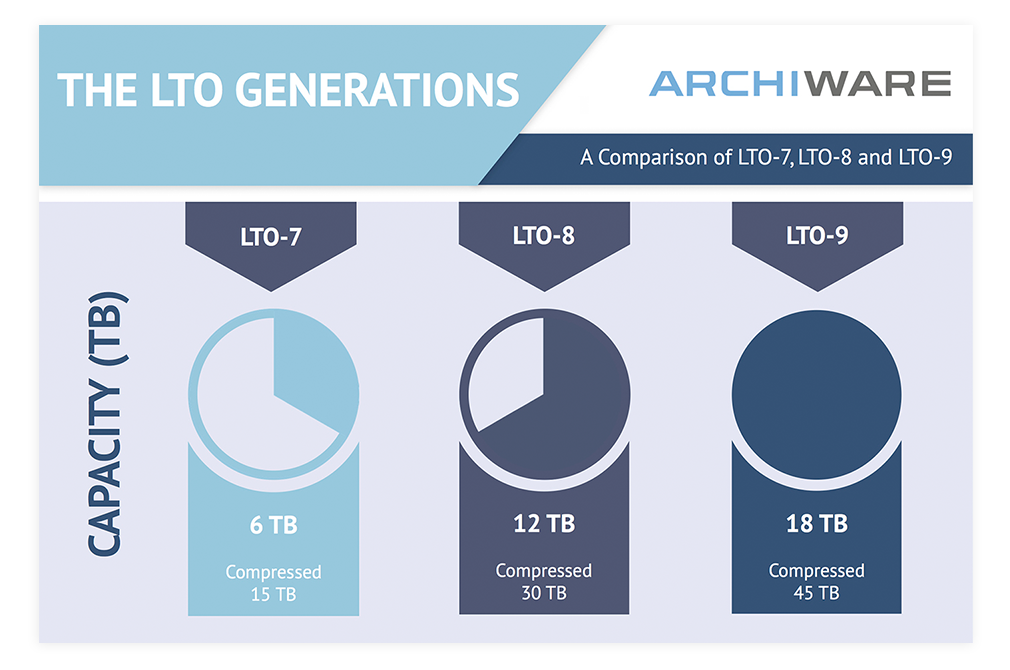
Compare LTO Generations

Compare different LTO generations with this helpful article and infographic. Learn how to choose the right LTO tape and discover the most important features and characteristics.

What is LTO Tape and How it Works

LTO means Linear Tape Open and is developed as a standard defined by the LTO consortium, consisting of IBM, HPE, and Quantum. There are multiple vendors and tape manufacturers. This article provides an overview of the power and utility of tape storage.

Components and Benefits

Find out if P5 is right for you!Download 30-Day free trial